Attack of the Killer Tomatoes

No Telling

Poisoned produce is nothing to joke about, especially when the poison has spread to Arkansas. There are a few things we get excited about down here. Watermelons, for instance. Hope, Arkansas is the Watermelon Capitol of the World, infamous for growing the tastiest and largest melons anywhere. We also grew a U.S. President down there, and another fellow who’d like to be one.

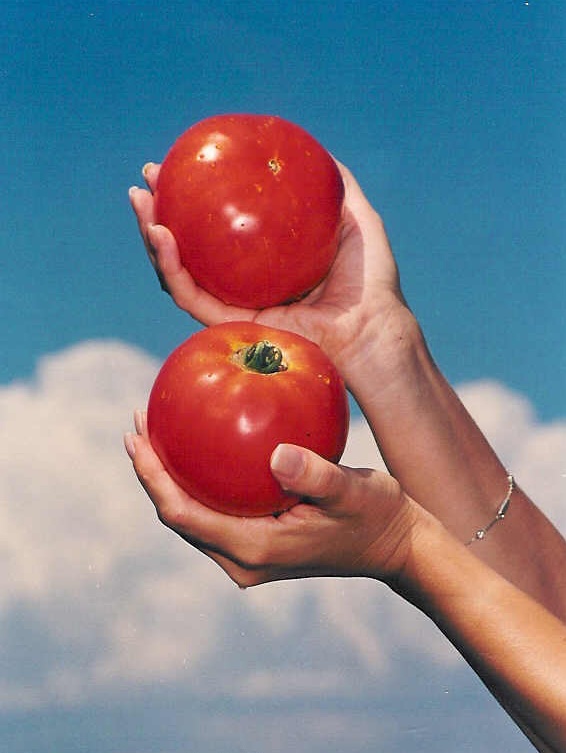
As excited as we get about watermelons, it’s nothing compared to the religion surrounding Arkansas home-grown tomatoes. Almost everyone has at least one plant growing in a sunny part of the yard. Folks with more than a 5′ x 5′ square of unused land usually tuck at least one tomato plant in among the marigolds. Those out in the county grow enough tomatoes to feed a small country. These are always for sale at sweltering roadside stands or out of the back of a pick-up truck. There are people, I tell you, whose sole commerce is to sell those tomatoes.

You can always buy them at a chain grocery store, and a lot of people do. A lot of people, I might add, who are checking their temperatures and waiting to feel queasy right about now. While we’ve been reassured that the Recent Tomato Unpleasantness (salmonella) involves only store-bought tomatoes, just the thought of dire illness has many wondering how to complete their summer without freshly salted and peppered tomatoes on a plate. It’s a little like telling us not to eat devilled eggs. We don’t know how to behave.

My daughter hit the drive-thru at Burger King the other day and came back with ominous tales of posted “no tomatoes here” signs. Same thing at McDonald’s. I reminded her that 1) she’s never eaten a tomato in her life, and 2) in the end, fast food is just as deadly as salmonella tomatoes, but I don’t think she cares. She spent her formative years listening to the Bush administration and is afraid of damn near everything, even tomatoes she doesn’t eat. I did my best, I really did.

No government agency seems to be able to explain why exactly all those store-bought tomatoes are tainted. I find that scarier than the actual salmonella.

In the meantime, it looks like the roadside stands, farmer’s markets, and pick-up trucks are going to be our only safe sources. Unless, of course, you’ve got a staked plant or two in a tub out back. If you have any extras, bring them over to me.

Alabama Girls Do All Right

Fresh Ribbon


Occasionally, I get a little Ebay-happy and bid on a typewriter I’m completely unsure of. The machine usually has a bad picture or a lackluster description. Sometimes I email the seller and get back either useless information or no email at all. This has happened to me three times and every single time I’ve lucked into a prize.

This one is prize number three. I’m always a fraidy-cat when it comes to opening The Box on the Porch when a new typewriter arrives. It’s the moment of truth, especially when the machine inside is a gamble. I paid almost nothing for this Royal Futura 800 – even less than the low shipping cost. Sometimes, though, you’ve got to put it in perspective: I’ve spent more on a dinner out at a mediocre restaurant. I’ve bought earrings more expensive than this. Just cruising past the Estee Lauder counter sets me back twice the cost of the shipping alone.

In the end, it was sent to the wrong address, poorly packed, and the case…well. I spent the better part of an hour just trying to get the rusted latch to open, when it might have been easier just to start ripping the leather away by hand.

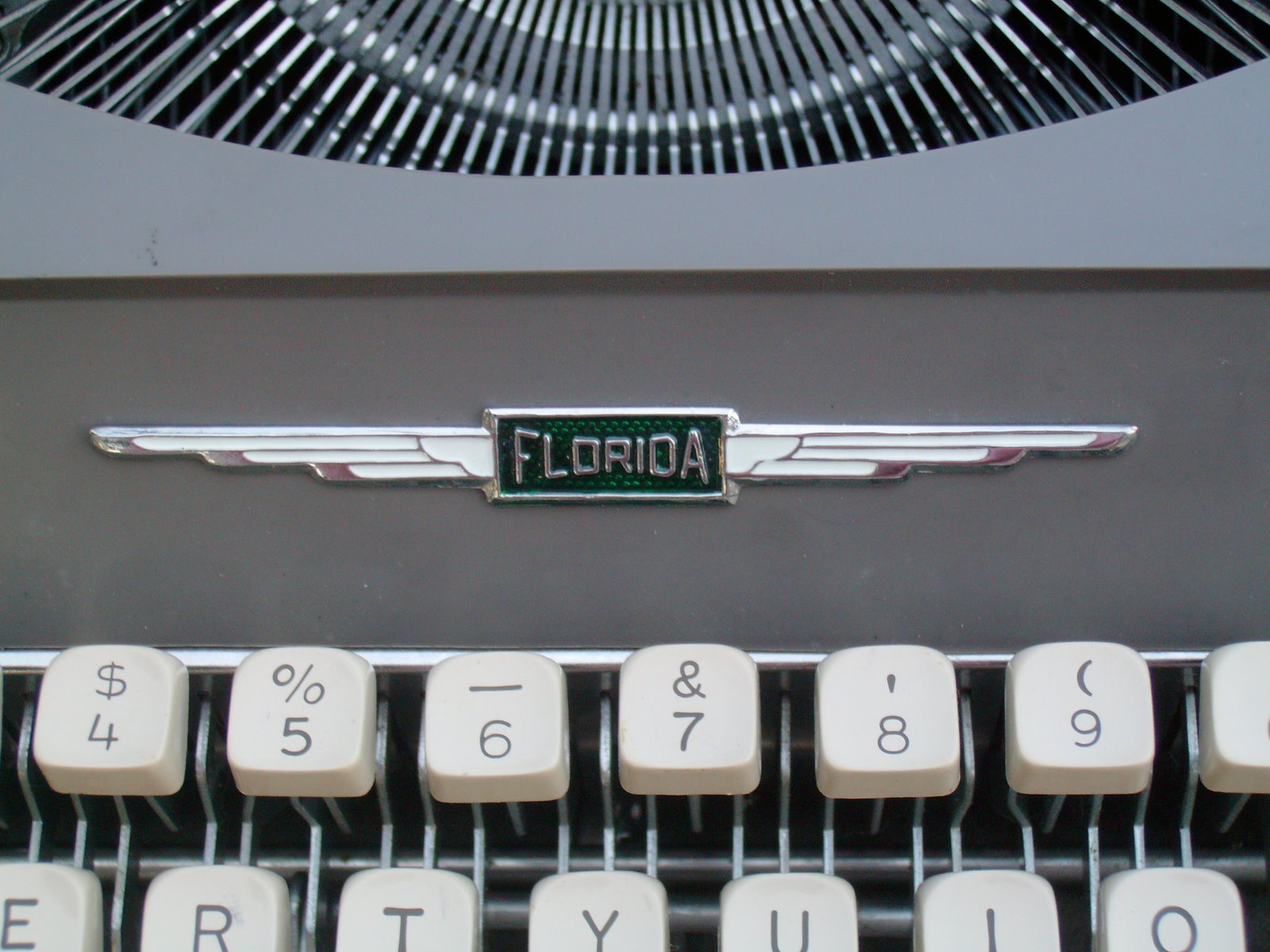
But look what was inside. Aside from Tallulah’s obvious beauty, all I had to do was put in a fresh ribbon and start typing. Just like that. I took her to my office the very next day and kept her on my desk as an everyday typer. The color is interesting – something between blush and band-aid, but it has an angelic, effortless touch. Ed at Acme Business Machines said that of all the typewriters I’ve ever brought him, this was his favorite. She’s such a coquette. Just look at her up there, posing in the gardenias.

She’s also a sassy Alabama girl with (literally) untapped ambition. Possibly a graduation gift to a young girl who’d rather marry her high school sweetheart than go to college, and so the gift languished, unused, and stored carefully away. Then uncarefully away as the kids and her life began to fill out. It’s possible this typewriter represented a regrettable decision and finally went to live with the shed spiders. Who knows.

So I named her Tallulah Bankhead, because sometimes good Alabama girls didn’t marry the sweetheart, sometimes they left home and became famous bad girls.

The Bottom Line

Fresh Ribbon

Photobucket

This little ditty from Modern Mechanix is confusing. I’m trying to remember EVER seeing a mirror taped to anyone’s desk and I get nothing.
I’m not making light of the real issue, however, which is quite serious. How DO you keep from running out of paper? How did we write all of those foot-noted papers in college without running out of room every single time?
I don’t remember. That was too long ago and I paid my roommate to type up my papers at $2 a page anyway. I was young. Typing papers was about layout perfection and margins and no white-out. Even though I bask in the glory of strikethroughs and fictional hyphenation strategies now, I remember when the whole world was ready to pound and pronounce upon the smallest mistake. Especially marginal mistakes. I didn’t type much back then.
I had an old boyfriend who, for a semester or two, channelled or copied or posed as Jack Kerouac. Or Sal Paradise. Or both. This was a common malady among my English major/poet boyfriends back then, but this one in particular liked to tape all of his pages together, one after the other, a la Kerouac, until he had a mountainous pile of over-inflated ego drivel. That’s how he solved The Problem of the Bottom Margin – no margins at all.
Later, Bob earned a Phd in Medieval Lit, then changed his name and became a rodeo announcer. Just thought I’d throw that in.
I handle the paper problem by cheating a bit with this fabulous lined and numbered legal paper. I just roll it in behind a sheet of perfect 9 lb. onionskin, peer through it, and voila – stop typing when the number “32” rolls up. Easy.
What’s your trick?

Women’s Wear

No Telling

I love reading other people’s blogs. There’s always something out there that trips a writing or remembering switch in me. These little moments from other posts would be my antidote to writer’s block – if I believed in it. I don’t, you know, and neither should you. I have a whole litany of blog subscriptions that I read every single day. One of these is The New Charm School: Jennifer Warwick’s Blog for Recovering Type A Types. The latest blog post on her grandmother’s dresses inspired me. And that’s a good thing, because this is the last official day for NaFloScribMo.

I’ve spent the last hour or so writing about my Grandma Monda’s dresses and the woman who wore them. Such a woman. And such dresses. As a little girl I spent hours trying on her clothes over and over again, hoping they would someday fit me so I could become her. She was a tiny slip of a woman, under five feet tall and weighing in the double digits. I was busy growing into a body much taller and larger, so I do remember a summer or a Christmas or both when the clothes almost fit. I was eight.

Grandma Monda had a signature color – kelly green. She had many fine things in her closets, but I’ve imprinted forever on a kelly green rayon dress with white polkadots. She always left a few dresses hanging in a closet at their old family house in Stamps, Arkansas and that green dress was among them. Since my grandparents lived in San Francisco, there were times that our little family spent time in Stamps without them. One of the first things I’d do is run to the closet to make sure the green dress still hung there, still smelled like her, and that the rayon still fell from my fingers like mercury. Grandma Monda was my light – was everyone’s light – and the reassurance of that closeted dress was all I needed. I could wait, then, for the next poem, the next letter, the next visit.

When my daughter was a very little thing climbing in my lap, a little of the same happened for her. I had three waffle-weave cotton dresses – all the same style but different colors. These were the go-tos, the things I wore when I wanted the most comfort and the late 80s version, I guess, of the 50s “house dress.” At one of my infamous yard sales I finally gave up the ghost of those dresses and hung them on strung clothesline in the yard.

Emily was beside herself. A school-girl by then, she whipped those dresses off the clothesline slinging hangers and sale tags. Her tears were furious. These are the dresses I love, she said, you can’t sell them. I was struck dumb and then apologetic first because I had no idea, and then because I perfectly understood what she meant. Those dresses were hours and hours of snuggling on the couch, hems used to wipe tears. The face of her babyhood rested against that cotton and those dresses were not for sale.

There’s powerful love in the clothes of our mothers, our grandmothers. I suspect it’s the hand-me-down loving easing its way into the warp and weft of our DNA. I think of all the women who painstakingly cut up old dresses into tiny pieces to refabric the geometry of their love by making quilts. Born-again comfort objects. Mama’s blue print dress scattered across it like stars.

Typing vs. Typesetting

Fresh Ribbon

I ran across this little ditty in my travels and it’s given me pause.

For the better part of the twentieth century, the distinctive forms of typewriter type (notably its single-character width and unstressed stroke) characterized the immediacy of thought: getting the idea down without dressing it up. Now that computers have replaced typewriters, most word processing programs default to Helvetica or Times Roman (or their derivatives) as the typographic expression of simple typing. […] As a typographer, you should recognise the difference between typing and typesetting. Time and usage may ultimately make Inkjet Sans the expected typeface for letters. For now, however, on paper, typewriter type is still the best expression of the intimate, informal voice — direct address. Imitating the formalities of typesetting in a letter is always inappropriate because it suggests an undeserved permanence — the end of a discussion, not its continuation. (John Kane, A Type Primer, p85)


I raised rent money during college by selling advertising for a local newspaper. At the time, that meant laying out the ads as well, and we did that on light tables with Exacto-knives and streamers of print from the typesetting machine. I wasn’t allowed to handle the typesetting machine, of course, because there was a Typesetter whose job it was to set type. A person who, by the way, made four times the money I did. It was a highly skilled position.

I’m beginning to believe the computer has turned us all into typesetters. As a matter of fact, I’m typesetting right now in various ways to make this little blog post presentable. I’m also editing and creating layout without sharp instruments or a light table, but it’s cut and paste and move and re-adjust all the same.

Well. I’ve called the act of throwing together this blog “writing,” but now I’m not so sure. And I’m feeling more than a little guilty that a whole skilled trade vanished while I was looking the other way – at a computer screen, no doubt.

Hi. I’m Monda and I’m an office supply addict.

No Telling

Ever since I was a little girl hanging out at my father’s desk, I’ve had a thing for office supplies. Yellow college-ruled legal pads, killer Swingline staplers that look like miniature Buicks, Flair felt-tip pens, copy sets you can load in a typewriter to make multiple, tissue-paper copies – pink ones. Oh, and empty “Blue Books” just made for writing tiny novels, steno pads with that fabulous “eye-ease” green paper, and boxes broken at the edges but stocked with hundreds of sheets of Eaton onionskin paper. I can’t even talk about my love affair with envelopes. It’s just too much.

You know, I lived the double-luck of having a father who was both a professor and a coach. You know what that means. Clipboards.

It was easy to keep me entertained and out of everyone’s way – Dad just sat me in the corner or at a spare table in his office (home or school), and there I’d stay scribbling and typing and stapling and creating. His Hendrix office sported an old Royal typewriter the color and weight of a boat anchor. At home, it was a spiffy early sixties Smith-Corona Galaxie. No one ever really taught me to type, and I never really learned in any productive way. It didn’t matter, though, since the whole point was to keep me busy and out of trouble. Besides, I had writing to do.

I imagine there are scores of teacher’s kids out there with the same accidental training. The other eventuality is this unhealthy craving for office supplies. It honed my tastes and made me quite particular about writing tools.

I’d rather write in my own blood than use a ballpoint pen, for example. And forget pencils. There’s just something about them that anticipates making a mistake. There’s nothing sexy about erasure and correction – I don’t like the temporary nature of that business. I’ve got a friend and colleague who refuses to use anything but yellow number two pencils of a particular make and model. Ticonderoga? Something like that. Bless his heart, is all I can say, because – writing instrument aesthetics aside – he’s having quite a time finding a damned pencil sharpener. They just don’t automatically install those in the back of every room like they used to.

Oddly enough, I’ve never craved fountain pens. Too scratchy. The only thing that pulled me away from felt-tip Paper Mate Flairs was the advent of gel pens, Uniballs in particular. I buy them by the box and always have about six jangling around in my purse. Ah, heaven.

Paper is where I get into real trouble. Those yellow, hardbacked, college-ruled legal pads are my siren song. Can’t stay away from them. Even though I’ve matured into more of a Moleskine XL Cahier kind of gal, I can’t leave Office Depot without at least one package of legal pads in tow. Besides, the Depot doesn’t sell Moleskine. For that I have to walk into a bookstore, and those trips only cause more shelving problems.

In my pre-Moleskine days, I bought stacks of chemistry notebooks. I still do, actually. For those of you unfamiliar, these are like composition books only more elaborately bound. The paper is that magical “eye-ease” green of old steno pads, but they’re college-ruled and the pages are numbered. As an angsty teen I bought these at the college bookstore and wrote page after numbered page of bad poetry covered in tears and cigarette burns. Last summer, I went to a lot of trouble to get those put on the college bookstore shelves again. Count on the fact that I always have at least one Moleskine and one chemistry notebook going at all times.

Just yesterday Strikethru introduced me to an entirely new affliction that I ordered immediately – Apica notebooks. I only bought one just in case, but I’m sure to soon start juggling three different scribbling books, dammit. Take a look at them – they’re irresistible and we can blame Strikethru.

Swingline staplers. The old ones never die or break, not even if you staple through leather or drop them fifty times. I have one on my desk right now that sat on my father’s desk in the sixites. It works like a charm and weighs a good three pounds – if I ever have the need it can double as weaponry. When it comes to staplers, newer is never better. At work, I’ve been through four plastic staplers in two years and good riddance to them all.
My addiction is too involved to fully explain in a mere blog post. To do it right, I’d need to make another trip to the Depot or some other Palace of Paper to get more supplies. Legal pads, probably. And file folders. Hmmm.